
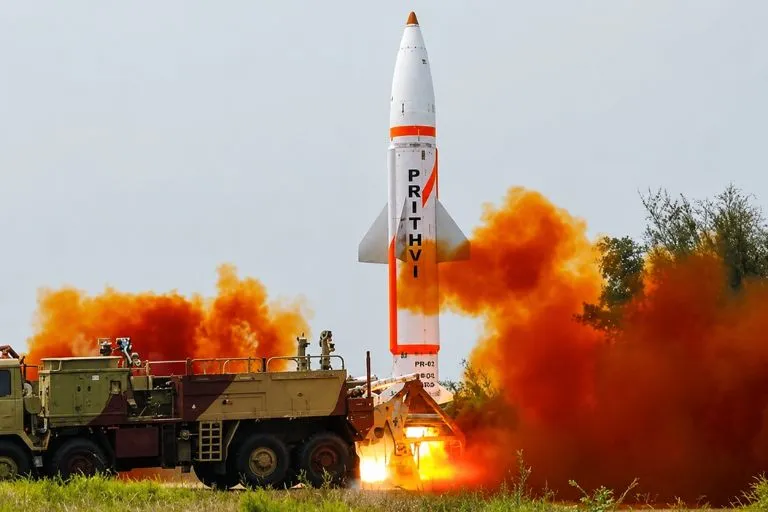
India is a recognised nuclear-armed state with a doctrine focused on deterrence, restraint, and responsible use of nuclear weapons.
One of the most critical pillars of this posture is its land-based nuclear missiles, which provide India with an assured retaliation capability in the event of a nuclear attack.
How Many Land-Based Nuclear Missiles Does India Have?
India does not officially disclose the exact number of its nuclear missiles or warheads.
However, based on open-source defence assessments and international security studies, India is estimated to possess around 70–80 land-based nuclear missile launchers.
These systems are controlled by the Strategic Forces Command, which is responsible for managing India’s nuclear assets.
The figures remain approximate, as India follows a policy of strategic ambiguity regarding its nuclear arsenal to enhance deterrence credibility.
6 Major Land-Based Nuclear Missiles in India’s Arsenal
India’s land-based nuclear missile capability is primarily built around the Prithvi and Agni missile families developed by the Defence Research and Development Organisation (DRDO).
Prithvi-II is a short-range ballistic missile with a range of approximately 250–350 kilometres.
Agni-I is a medium-range ballistic missile with a range of about 700 kilometres, designed mainly for regional deterrence.
Agni-II has a range exceeding 2,000 kilometres, enhancing India’s strike depth.
Agni-III extends India’s reach to around 3,000 kilometres and strengthens long-range deterrence.
Agni-IV is an advanced intermediate-range missile capable of striking targets up to 3,500 kilometres.
Agni-V, with a range of about 5,000 kilometres, significantly expands India’s strategic reach and deterrence capability.
These missiles are largely road-mobile, which improves survivability and reduces vulnerability to pre-emptive strikes.
Role of Land-Based Missiles in India’s Nuclear Doctrine
India follows a No First Use policy, meaning nuclear weapons are intended solely for retaliation after a nuclear attack. Land-based missiles play a crucial role in making this doctrine credible by ensuring assured second-strike capability.
Their mobility, dispersion, and readiness allow India to maintain deterrence while avoiding aggressive posturing.
Land-Based Missiles within India’s Nuclear Triad
India’s nuclear strategy is built on a triad comprising land-based missiles, air-delivered nuclear weapons, and sea-based nuclear forces.
Land-based missiles provide stability and immediate response capability, complementing the flexibility of air power and the survivability of submarine-based systems.
This integrated structure ensures that India can respond effectively under all strategic circumstances.
Present Capability and Future Outlook
India’s current land-based missile force is assessed to be sufficient for its declared doctrine of credible minimum deterrence.
Ongoing development of newer systems, such as Agni-P and next-generation platforms, aims to improve accuracy, mobility, and operational efficiency rather than increase numbers.
India’s focus remains on maintaining strategic balance rather than entering a quantitative arms race.
Conclusion
India’s land-based nuclear missiles form the backbone of its nuclear deterrence framework.
With an estimated 70–80 operational launchers, a diversified missile inventory, and integration into a robust nuclear triad, these systems ensure national security and strategic stability.
India’s approach reflects restraint, responsibility, and a commitment to deterrence rather than escalation.