

Introduction
Bihar, one of India’s oldest and most historically rich states, has long struggled with economic underdevelopment. Many experts and policymakers often ask whether Bihar’s landlockedness — its lack of direct access to the sea — is the main reason behind its slow progress. While geography plays a role, it is not the only or even the dominant factor holding Bihar back.
Understanding Landlockedness
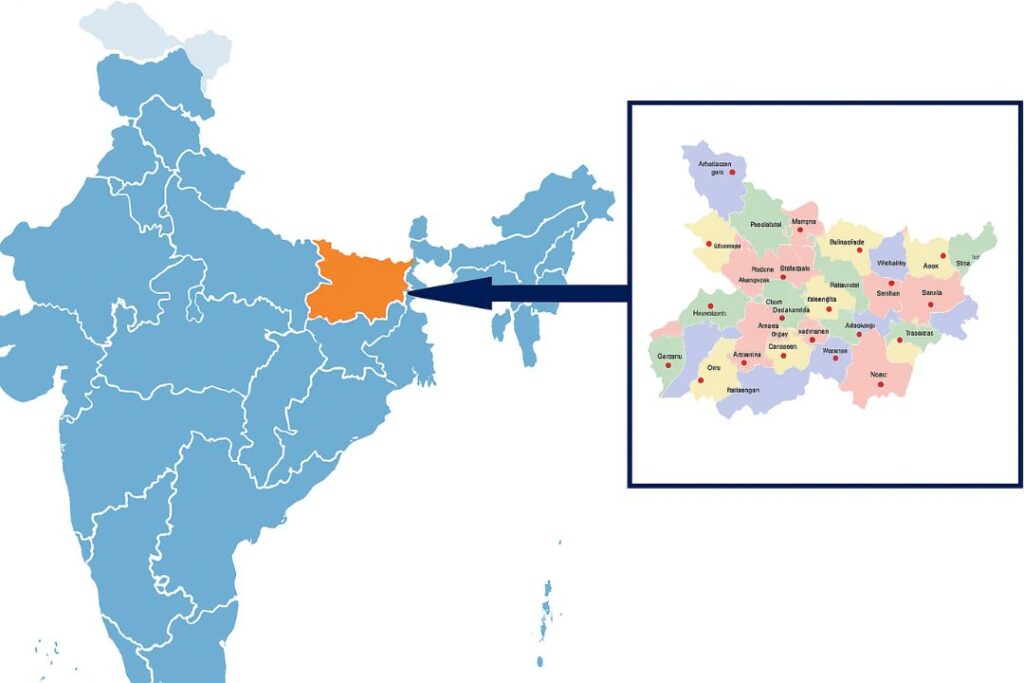
Landlockedness refers to the condition of a region or country that has no direct access to the ocean or sea. This absence limits opportunities for maritime trade, increases transportation costs, and can restrict global connectivity. Around the world, landlocked nations like Nepal, Afghanistan, and Chad face similar economic constraints.
However, being landlocked does not automatically mean underdeveloped — countries such as Switzerland and Austria have thrived despite having no coastline. This suggests that while geography influences development, policy, infrastructure, and governance determine how severe that impact becomes.
Bihar’s Geographical Position: A Natural Limitation
Bihar’s location between Uttar Pradesh, Jharkhand, and West Bengal means it depends on neighboring states for access to ports like Kolkata and Haldia.
This dependency leads to:
- Higher logistics and export costs for industries
- Limited foreign trade opportunities
- Reduced attractiveness for large-scale industrial investments
Yet, these challenges could be managed with proper infrastructure and connectivity, as seen in other inland states.
Trade and Connectivity Challenges
Due to its landlocked geography, Bihar faces several logistical disadvantages:
- Poor transport infrastructure: Many rural areas lack efficient road and rail networks
- Limited industrial corridors: Most major industries prefer coastal or central states with better connectivity
- Dependency on river transport: The Ganga Waterway Project aims to improve trade through inland water routes, but progress has been slow
While the Eastern Freight Corridor and National Waterway-1 projects promise improvement, they are yet to fully realize Bihar’s potential as a trade hub.
Beyond Geography: The Real Barriers
Bihar’s underdevelopment cannot be explained by geography alone. The state also faces long-term structural and social issues:
- Governance and policy gaps: Decades of weak governance, corruption, and poor administration have slowed progress
- Low industrialization: Most of Bihar’s economy relies on agriculture, with limited manufacturing and service-sector growth
- Human capital challenges: High population, low literacy rates, and skill gaps reduce workforce productivity
- Outmigration: Millions of workers leave Bihar each year in search of better employment, draining local talent
These issues combined have a far greater impact than being landlocked.
Learning from Other Landlocked Success Stories
States like Madhya Pradesh and Haryana, though landlocked, have achieved significant economic growth. Their success comes from:
- Robust infrastructure and highways
- Industrial incentives for investors
- Strong governance reforms
This proves that effective planning and leadership can overcome the limits of landlockedness.
Can Bihar Overcome the Landlocked Barrier?
Yes — but it requires strategic vision. Some key steps include:
- Investing in logistics and connectivity, especially linking to eastern ports
- Promoting inland water transport along the Ganga
- Encouraging industrial clusters near border areas for easier trade access
- Enhancing skill development and education to attract investment
- Strengthening governance and transparency to improve investor confidence
If these policies are implemented effectively, Bihar’s location could transform from a disadvantage into an opportunity.
Conclusion
Landlockedness may have created logistical and economic challenges for Bihar, but it is not the root cause of its underdevelopment. The state’s journey toward growth depends far more on governance, infrastructure, and policy execution than on geography alone. With proper investment, planning, and leadership, Bihar can rise above its landlocked limitations and build a more prosperous future.
Follow our website for more insightful blogs related to Bihar and its development journey.